

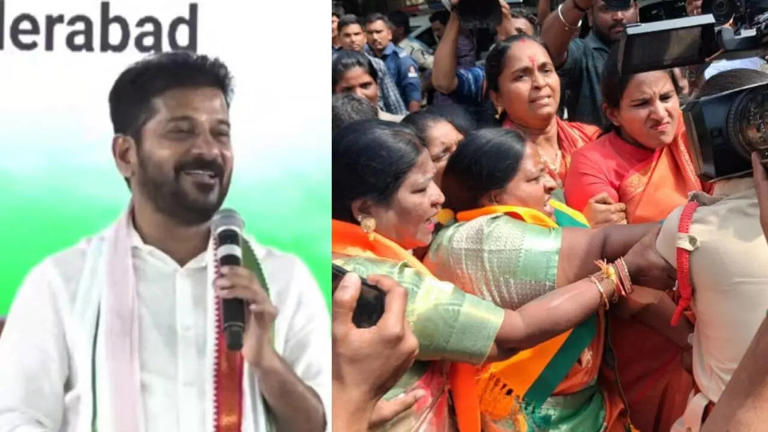
Telangana Chief Minister A. Revanth Reddy’s comments comparing Congress’s diversity to Hinduism’s plurality have triggered a major political storm in Hyderabad. Senior BJP leaders accused him of making “anti-Hindu” remarks, party workers burnt his effigy outside the BJP state office, and statewide protests were called. Here’s a clear, balanced explainer of what he said, why it’s controversial, how parties responded, and what to watch next.
Introduction: How a remark became a flashpoint
In an internal Congress meeting, Revanth Reddy drew an analogy between the range of views inside Congress and the diversity of practices within Hinduism. The phrasing—invoking examples of different deities and folk traditions—sparked sharp reactions from BJP leaders, who framed it as an insult to Hindu sentiments. Protests erupted in Hyderabad, with a call for statewide demonstrations.
What exactly did Revanth Reddy say?
- Context: Addressing a party executive meeting, Reddy argued that Congress accommodates varied viewpoints, similar to Hinduism’s many forms of worship.
- The line that triggered the row: He asked rhetorically, “How many Gods are there in Hinduism—3 crore?” and cited examples of devotees and folk traditions (Hanuman for unmarried, offerings of alcohol and chicken to local deities like Yellamma, Pochamma, Maisamma), to illustrate plurality. He then said consensus is difficult on gods, so perfect consensus on political leaders is also unlikely.
- Core message (per his framing): Congress’s internal differences reflect a broader culture of plurality, yet the party functions through freedom and diversity.
- Effigy burning and protests: BJP workers demonstrated outside the state party office; statewide protests were called for December 3. Leaders said the remarks insult deities and denigrate Hindu practices.
- Kishan Reddy’s charge: He urged Hindus to unite, alleging the CM’s “arrogant” language was influenced by political alliances, and asked voters to “show the power of Hindus” through the ballot.
- National leaders weigh in: Giriraj Singh called it part of a “campaign against Hindus” and attacked Congress’s cultural stance; Sambit Patra termed the language “objectionable and hateful.”
- TTD board member’s demand: An apology for “hurting sentiments,” warning such statements have consequences when they target long-standing traditions.
Congress’s internal caution and political framing
- Within Congress, voices urged careful language to avoid perceptions of insult, even while defending the idea of pluralism. The episode highlights the fine line between describing diversity and appearing to mock faith practices.
- Reddy’s organisational message: He asked party leaders to let go of personal grievances and accept that complete consensus is unrealistic—an internal discipline pitch that got overshadowed by the controversy.
What this means politically
- Short-term: BJP will amplify the clip to mobilise Hindu consolidation; protests keep the issue alive across news cycles.
- Medium-term: Expect demands for clarification or a softer tone; a carefully worded statement stressing respect for faith traditions could defuse tensions while restating the plurality point.
- Long-term: The quote may become archival material in future campaigns, resurfacing in state and national narratives to frame Congress as culturally insensitive—unless the Congress counters with proactive outreach to faith communities.
Key takeaways
- Plurality vs. perception: Explaining diversity through religious examples can backfire if phrasing implies ridicule; neutral terminology and context-setting matter.
- Street optics drive momentum: Effigy burnings and statewide calls magnify a clip’s reach beyond its original audience.
- Likely off-ramp: A clarification that reiterates respect for all deities and traditions, while maintaining the idea of political inclusivity.
Conclusion: What to watch next
Watch for three signals: (1) a formal clarification stressing respect for Hindu traditions, (2) whether statewide protests sustain or taper, and (3) if the remark becomes a recurring campaign motif. In polarised climates, language choices carry outsized political costs; expect both parties to recalibrate messaging while leveraging the moment for mobilisation.
