

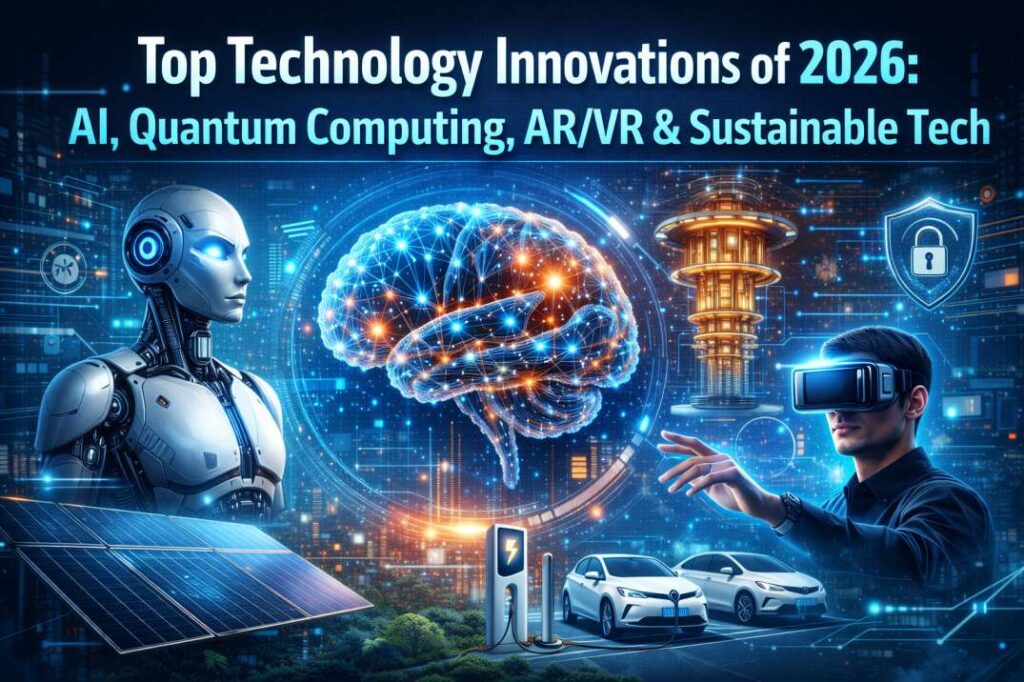
Technology news 2026: Shaping the Future of Our World
Technology continues to evolve at an unprecedented pace, influencing how we work, live, and interact. The year 2026 brings a host of innovations that are transforming industries, enhancing daily life, and redefining human potential. From artificial intelligence to sustainable solutions, these breakthroughs are shaping the future in ways that were once unimaginable
Artificial Intelligence: Smarter, Faster, and More Human
Artificial Intelligence (AI) has grown beyond simple automation or predictive analytics. In 2026, AI is becoming a part of everyday life, supporting healthcare, education, business, and personal productivity.
Healthcare Applications: AI-driven tools are revolutionizing healthcare by providing accurate diagnostics, personalized treatment plans, and even early detection of diseases. For example, machine learning algorithms can now detect cancers or heart conditions from medical scans faster and more accurately than human specialists. AI-powered telemedicine platforms provide virtual consultations and monitor chronic conditions, improving patient outcomes while reducing hospital visits.
Business & Industry: Companies are leveraging AI for predictive analytics, customer personalization, and operational optimization. Retailers use AI to anticipate customer preferences, while logistics companies optimize delivery routes using real-time data. AI is also transforming creative industries—design, content creation, and media production are increasingly enhanced by AI tools that support human creativity.
Ethics & Governance: With AI’s growing influence, ethical considerations are becoming critical. Organizations are investing in transparent, accountable AI systems that minimize bias and prioritize privacy. In 2026, ethical AI is not just a goal—it’s a necessity.
Quantum Computing: Unlocking the Impossible
Quantum computing promises to solve problems beyond the reach of classical computers. In 2026, we are beginning to see real-world applications in medicine, finance, and logistics.
Drug Discovery & Healthcare: Quantum simulations allow researchers to model complex molecular interactions, speeding up the development of life-saving drugs and vaccines. This technology could potentially shorten the time it takes to discover treatments for diseases like Alzheimer’s or cancer.
Finance & Risk Management: Quantum computers enable real-time analysis of massive financial datasets, helping institutions predict market trends, optimize investment portfolios, and manage risks more effectively.
Logistics & Supply Chains: By solving complex optimization problems, quantum computing improves routing, resource allocation, and supply chain efficiency, reducing costs and carbon footprints.
Though still in its infancy, quantum computing is set to revolutionize industries that depend on large-scale data analysis and complex problem-solving.
5G and Edge Computing: Real-Time Connectivity
The expansion of 5G networks, paired with edge computing, is transforming connectivity in 2026. These technologies are enabling faster, low-latency communication that supports critical applications across industries.
Smart Cities: Real-time data from sensors improves traffic management, energy usage, and public safety. Cities are now capable of predictive maintenance for infrastructure, reducing downtime and increasing efficiency.
Autonomous Vehicles: Self-driving cars require high-speed, reliable communication. 5G networks allow vehicles to exchange data instantly, ensuring safety and efficient navigation.
Industrial IoT: Factories, warehouses, and production lines use edge computing to process data locally, enabling faster decision-making, predictive maintenance, and reduced downtime.
The combination of 5G and edge computing is critical for powering connected devices, from smart homes to autonomous drones and beyond.
Immersive Technologies: AR, VR, and the Metaverse
Augmented Reality (AR) and Virtual Reality (VR) are changing the way we learn, work, and socialize. In 2026, immersive technologies are moving beyond entertainment into practical applications across multiple sectors.
Education: Virtual classrooms and interactive simulations enhance learning, allowing students to explore historical events, conduct scientific experiments, or learn complex skills remotely.
Retail & E-Commerce: AR apps let customers virtually try on clothes, test furniture in their homes, or preview products in 3D, creating a more personalized shopping experience.
Work & Collaboration: VR-powered virtual offices allow global teams to collaborate in immersive digital spaces. Holographic presentations, 3D modeling, and remote design reviews are becoming standard practice in professional settings.
The Metaverse: Digital ecosystems are emerging where social interactions, business, and entertainment converge. Companies are exploring virtual marketplaces, concerts, and events within the metaverse, creating new economic and social opportunities.
Robotics & Automation: From Factories to Homes
Robotics technology is advancing rapidly, moving from industrial environments into everyday life.
Healthcare Robotics: Surgical robots enhance precision in complex operations, while robotic exoskeletons assist patients with mobility challenges. Hospitals use service robots for cleaning, delivering supplies, and even providing companionship to patients.
Logistics & Delivery: Autonomous drones and warehouse robots streamline inventory management and last-mile delivery, reducing costs and improving efficiency.
Domestic Robotics: Household robots now help with chores like cleaning, cooking, and organizing, freeing up time for personal and creative activities.
Industrial Automation: AI-driven robots collaborate with humans in factories, improving safety, efficiency, and productivity. Automation reduces repetitive tasks while allowing humans to focus on strategic and creative work.
Sustainable Technology: Greener, Smarter Solutions
Environmental sustainability is a major focus in 2026. Green technology is helping businesses and individuals reduce their carbon footprint while improving efficiency.
Smart Homes & Buildings: Solar panels, energy-efficient appliances, and AI-driven energy management systems reduce energy consumption and costs. Smart homes adapt automatically to user behavior, optimizing lighting, temperature, and power usage.
Transportation: Electric vehicles (EVs), hydrogen-powered vehicles, and smart charging networks are reducing reliance on fossil fuels. Autonomous EV fleets are emerging as a solution for eco-friendly urban transport.
Industry & Manufacturing: Sustainable production processes, recycled materials, and carbon-neutral factories are becoming standard. Companies are increasingly embracing sustainability as both a social responsibility and a business advantage.
Cybersecurity: Protecting a Connected World
As technology advances, so do cyber threats. In 2026, robust cybersecurity solutions are essential to protect individuals, businesses, and governments.
AI-Powered Threat Detection: Artificial intelligence identifies suspicious patterns, predicts potential attacks, and responds to breaches faster than traditional methods.
Biometric & Multi-Factor Authentication: Security now relies on fingerprints, facial recognition, voice identification, and behavioral patterns to protect sensitive data.
Blockchain & Decentralized Security: Distributed ledger technology ensures data integrity, prevents tampering, and adds a layer of security for financial transactions and personal records.
Cybersecurity is no longer just an IT concern—it is a cornerstone of trust in a fully connected digital world.
Conclusion: Staying Ahead in a Rapidly Evolving World
The year 2026 represents a remarkable era in technological advancement. From AI and quantum computing to immersive AR/VR experiences, robotics, sustainable innovations, and advanced connectivity, the pace of change is unprecedented.
Individuals, businesses, and governments that embrace these technologies, adapt quickly, and invest in innovation will be the ones to thrive. The future is not just coming—it’s being built today, and technology is the blueprint.
Staying informed, learning continuously, and leveraging emerging tools.
