

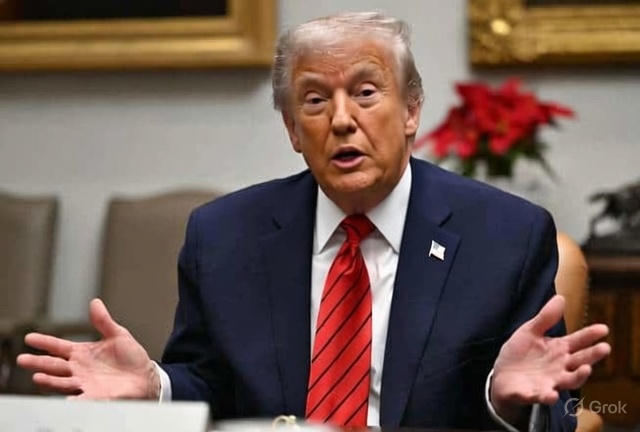
In a major announcement that has triggered global debate, U.S. President Donald Trump unveiled his new premium immigration pathway called the Gold Card Visa, aimed at retaining highly skilled foreign graduates in the United States. During the launch, Trump emphasized that it is a “shame” that countless talented students from countries like India and China are forced to leave the U.S. after completing their degrees, despite being some of the top performers in American universities.
The remarks were made during a meeting with global business leaders including Arvind Krishna (IBM CEO) and Michael Dell, where Trump outlined why the current system “pushes out the world’s brightest minds” and how the Gold Card is intended to fix this long-standing immigration challenge.
🇺🇸 Trump’s Statement: “A Shame Students Have to Leave After Graduating”
Trump directly addressed the issue faced by international graduates:
“Many students who come to America, who graduate from the best universities — they have to go back to India, they have to go back to China. It’s very, very hard for them to stay… It’s a shame.”
He added that the current visa system is “ridiculous” because:
- The U.S. invests in educating global talent
- Students secure high-ranking degrees in STEM, business, and research
- But outdated visa rules force them out of the country
Trump argued that these students are critical to America’s innovation ecosystem:
- They help major companies grow
- They create new businesses
- They contribute to tech, healthcare, and engineering advancements
What Exactly Is the Gold Card Visa? Full Breakdown
The Gold Card Visa is being positioned as a fast-track pathway to U.S. residency for highly skilled international individuals — especially students graduating from top U.S. universities.
Key Features of the Gold Card Visa
Here is the program explained in detail:
1. High Endorsement Fee
Applicants must pay a non-refundable $15,000 processing fee.
2. Mandatory Financial Commitment
Successful applicants must make a significant contribution:
- $1 million payment to the U.S. government
- This is positioned as an investment to support the American economy
3. Corporate Sponsorship Option
Companies can sponsor highly qualified foreign employees by paying:
- $2 million per sponsored candidate
4. Priority Processing
The Gold Card promises:
- Faster approval
- Direct path to residency
- Clear long-term immigration certainty
5. Stronger Than a Green Card
According to Trump, the program gives employers and applicants more stability than the standard green card system, which is often:
- Slow
- Backlogged
- Unpredictable
Why Indian Students Are at the Center of This Debate
Indian students make up one of the largest international student groups in the U.S., especially in:
- Engineering
- Computer Science
- MBA programs
- Medicine
- Data Science and AI
Many of them graduate from prestigious institutions, but still face:
- Long H-1B waits
- Lottery uncertainty
- Visa backlogs
- Pressure to return home despite job offers
Trump’s comments directly reflect this reality, acknowledging that:
- India supplies some of the best STEM talent to the U.S.
- But outdated rules prevent them from staying
- American companies lose valuable workforce due to visa limits
What U.S. Businesses Told Trump
During the meeting, business leaders expressed frustration with the current situation:
- Companies invest heavily in training skilled graduates
- But many are forced to leave due to visa rules
- This disrupts corporate planning and slows innovation
One CEO reportedly told Trump:
“We train them, they become top employees, and then suddenly we can’t keep them.”
The Gold Card is intended to solve this corporate challenge.
What Critics Are Saying About the Gold Card Visa
While the program aims to attract talent, critics argue that:
- It favors the wealthy
- It may not be accessible to ordinary students
- It resembles a “pay-to-stay” scheme
- Existing immigration issues remain unaddressed
Immigrant advocacy groups say:
- The U.S. should strengthen H-1B and green card reforms instead
- High fees may create inequality
- Only top earners will benefit
🇮🇳 Impact on Indian Students & Professionals
If implemented effectively, the Gold Card Visa could:
Allow talented Indian graduates to stay in the U.S.
Reduce dependency on the H-1B lottery
Provide a stable path to residency
Help Indian IT & tech professionals secure long-term careers
Strengthen India-U.S. educational and tech relations
However, the $1 million requirement may put the program out of reach for many students unless:
- Companies sponsor them
- Scholarships or subsidies emerge
- New rules ease investment criteria
Why This Announcement Is Making Global Headlines
This story is trending because:
- It involves U.S. immigration — a globally sensitive topic
- It affects millions of Indian families
- Trump openly acknowledged a long-criticized problem
- The Gold Card is seen as one of the most unusual visa proposals ever made
- It could reshape the future of global tech talent movement
Conclusion: A Bold Move or an Expensive Barrier?
Trump’s acknowledgment that it’s “a shame” for Indian students to leave the U.S. has struck a chord with millions. The Gold Card Visa aims to address a major gap in American immigration policy.
However, the high cost, exclusive nature, and political complexities around the proposal leave many questions unanswered.
As the debate grows, students, corporate leaders, and global experts are watching closely to see how this policy evolves — and how it will impact the future of Indian talent in the United States.
